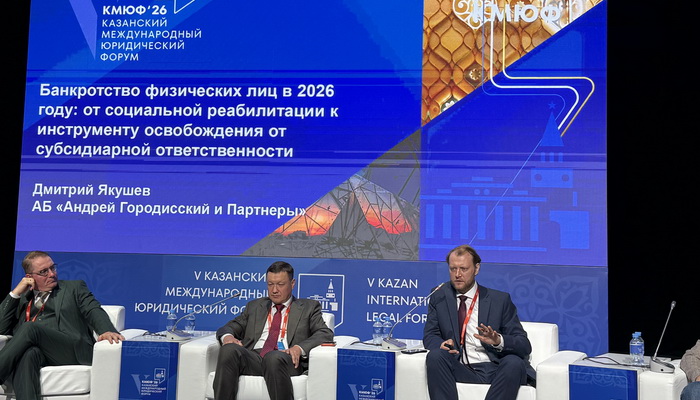

The V anniversary Kazan International Legal Forum was held in Kazan on September 24 and 25, 2026. As usual it took place at the building of the Tatar State Academic Theater named after Galiasgar Kamal.
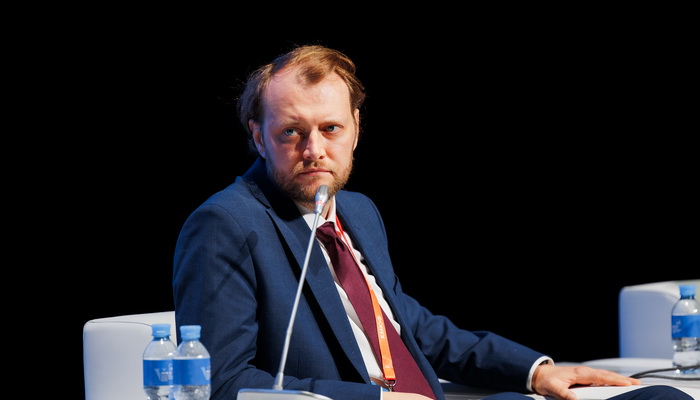
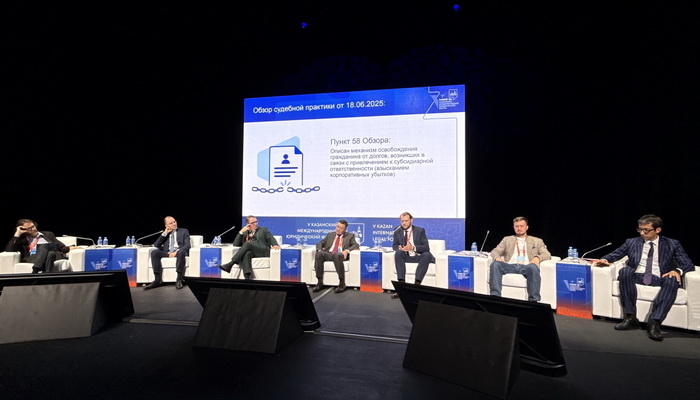
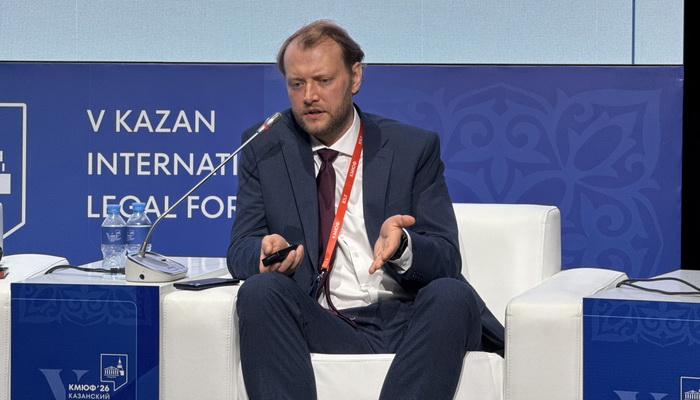
Dmitry Yakushev, Attorney and Counsel of Andrey Gorodissky & Partners Law Firm’s Bankruptcy practice team, delivered in the ‘Bankruptcy of individuals’ session a report on the following topic: ‘Bankruptcy of individuals in 2026: from Social Rehabilitation to the instrument for the release from secondary liability’.
Dmitry told about the evolution of the case law since the date of issue of the Summary of Court Rulings of the RF Supreme Court of June 18, 2025. That Summary for the first time featured the mechanism allowing an individual to get free in the personal bankruptcy procedure of the debt which resulted from imposition of the secondary liability. Previously, such debts were considered perpetual ones and it was impossible to write them off within the personal bankruptcy procedure.
Dmitry noted that the softening of the stance of the Supreme Court of the Russian Federation on this issue represents an attempt by Russian jurisprudence to incorporate elements of the so-called ‘fresh start’ concept, which is well-known and actively progressing in foreign legal systems. The essence of this concept is that an honest debtor facing financial hardships should have the chance to be released from the debt and start life anew, rather than bearing the burden for a lifetime.
According to Dmitry, the previous strict rules, intended to raise a fear of facing secondary liability, had the opposite effect. Realizing he would never be able to settle his debts, the debtor saw no point in cooperating with creditors and would hide assets long before any potential bankruptcy, while creditors, having obtained an unenforceable judgment, were forced to spend years searching for assets, challenging transactions, and expending resources on litigation.
Dmitry reminded that, under the new rules, the write-off of such debts is possible if two conditions are met. The first one is the absence of direct intent to cause harm to creditors or of gross negligence. It should be established by the court that the individual’s actions involved ordinary negligence. For instance, where the CEO was held secondarily liability for failing to hand over documents of the controlled legal entity to the bankruptcy trustee on the grounds that the documents had been lost and the CEO had made no attempt to restore them.
The second condition is that the individual co-operated with the financial receiver in course of the personal bankruptcy.
However in a real-case scenario, according to Dmitry, a great many issues arouse. Does the imposition of the secondary liability mean that the form of guilt has already been established? Where it should be established: in the company bankruptcy case or later in the personal bankruptcy procedure? Will this constitute a review of a court ruling on secondary liability that has already entered into force, or will it be a standalone, pinpoint legal mechanism?Dmitry drew attention to the fact that in the vast majority of cases involving secondary liability, courts do not assess the form of fault regarding the actions that led to the bankruptcy, specifically, whether the controlling person acted (or omitted) with intent or whether the harm was caused by gross or ordinary negligence. In a company bankruptcy case, the issue of the form of fault is not a core one. The task of the court is to establish that the actions (or omissions) of the controlling person led to the bankruptcy.
In personal bankruptcy proceedings, the court will address a different issue: whether the individual is worthy of a discharge of the debt. It is precisely here that the court is to assess the form of fault: whether it was the intentional infliction of harm, gross negligence, or simple carelessness. Thus, in Dmitry’s opinion, the new legal mechanism does not constitute a review of the judicial act imposing secondary liability; rather, it serves a specific purpose, namely, to determine, within the context of personal bankruptcy, the degree of guilt and decide whether the individual will be discharged from the debt or remain burdened by it indefinitely.
KILF is a respected annual forum for discussion of key legal matters that assembles thousands of participants from Russia and foreign countries.
The focal point of this anniversary forum was the unity of the law. Discussions on this topic touched upon how the law can unite people and countries even in the face of major challenges, remaining a foundation for stability and mutual respect.
KILF’s principal objective is fostering professional dialogue, sharing best practices, and facilitating the development of the legal system.